Agthia tripled its household base for a 6.5% revenue lift. The water cooler market models the wrong number
By Zenith Water Dispense Team ·
A Gulf water group bought a rival home delivery business and expected to triple its household customer base. The guided revenue uplift was in the mid single digits. That gap shows which of the two numbers in a water dispense model actually carries the money.
I used to treat a shaky machine count as the worst flaw in a market model. One sensitivity run changed my mind. In our UAE model the cooler count can swing by close to a third. The revenue line barely moves.
Agthia, the food and beverage group listed in Abu Dhabi, completed its purchase of Riviere in 2025. The group said the deal would roughly triple its household customer base. It also guided to a rise of about 6.5% in Water & Food segment revenue.
Tripling the customer count moved revenue by single digits
Agthia took 100% of Riviere and did not publish a price. The assets named in the announcement were physical: more than 160 delivery trucks and three bottling plants. Management called the deal immediately earnings accretive.
Then read the two figures side by side. The household account base roughly trebles. Segment revenue moves by roughly 6.5%. The money in a delivery book sits in litres and in route density. The number of names on the ledger is a weak guide to either. Household accounts are small, they order little, and they sit far apart. A buyer who priced that deal on customer count would have paid for the wrong asset.
Two numbers, and only one of them pays
Every dispense model rests on two inputs. How many dispense points exist, and how much each point pays or draws. Which of the two carries the revenue changes market by market.
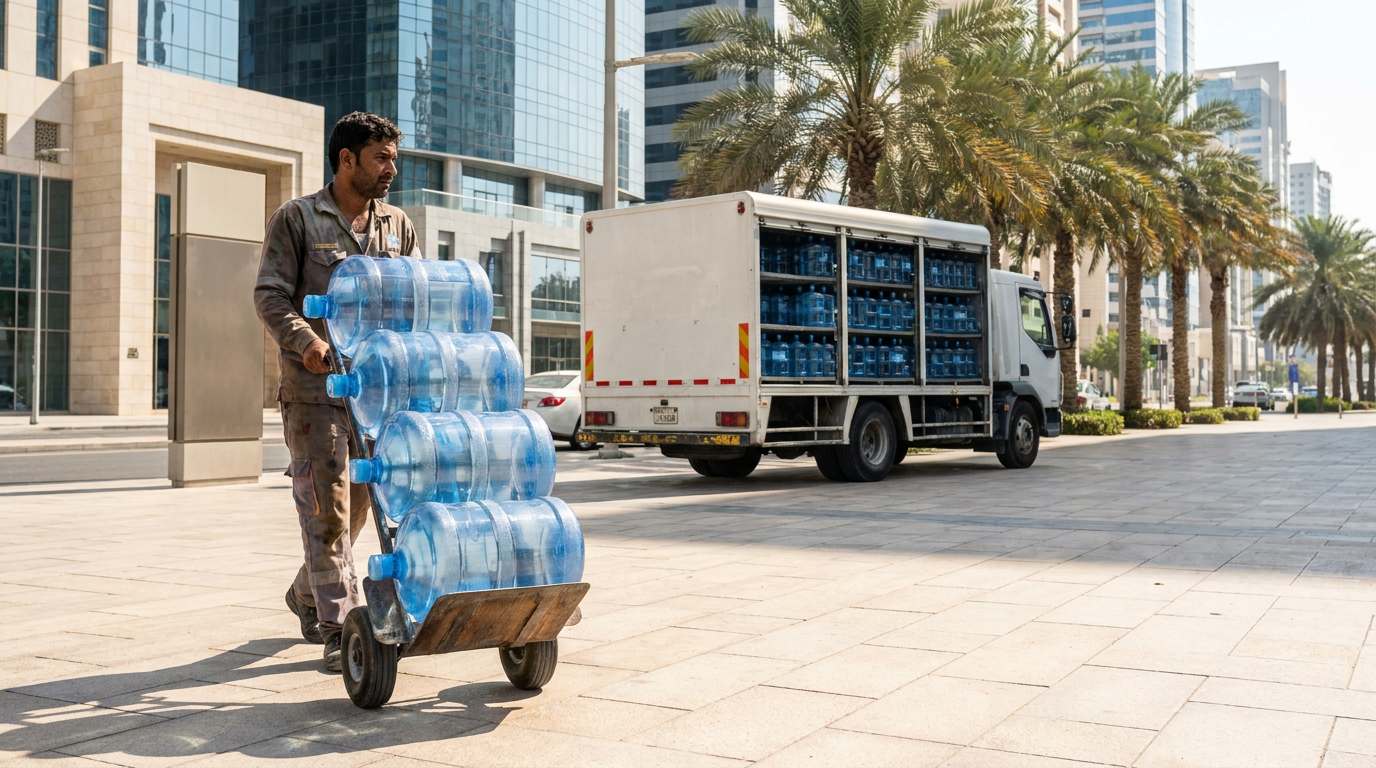
A cooler fed by delivered 19 litre bottles counts as BWD, bottled water dispense. In a delivery led market the water is nearly the whole invoice. The machine is often sold outright for a token sum or given away. So revenue tracks litres. You can be a third out on the machine count and still land close on the revenue. A plumbed machine sits in POU water, point of use, where a monthly rental usually is the invoice. There revenue tracks units, and a 5% unit error is a 5% revenue error.
Your sensitivity analysis should point at whichever input carries the money. Most of them point at the machine out of habit.
The boiling tap business is the mirror image
Quooker UK filed turnover of 80.6m pounds for 2023, up from 72.4m. Product sales were 73.5m of that. Parts and services came to 7.0m. Pre-tax profit was 3.2m pounds, and headcount went from 76 to 117 in the year.
So about nine tenths of the revenue is the unit itself. Counter-top boiling and sparkling machines, the ITS or instant taps segment, are usually sold rather than rented. Built that way, one per cent off the unit count is one per cent off revenue. There is no water line to absorb it. The margin is thin enough that the error lands straight on profit.
Europe does not give one answer either
Our own price series makes the same point inside Western Europe. The monthly bottled rental spans two orders of magnitude across the region. In some markets the cooler is effectively free and the bottle is the business. In others the rental is a real monthly charge that a customer notices.
Two countries can run the same machine and share nothing else about how it earns. One pan-European assumption about where the revenue sits will be wrong in roughly half the countries. The test has to be run country by country.
The pipework nobody in the deal owns
There is a case for bottled that rarely gets made in diligence. A plumbed machine puts the operator downstream of pipes it does not own and cannot inspect. When a water quality complaint lands, the argument about whose fault it was gets slow and expensive. A sealed bottle ends that argument at the cap.
Age of stock matters here. A 1970s riser with a tank on the roof is a different risk from a new build. Bottled dispense carries no liability for the building's own plumbing, and a careful buyer will pay for that. Bottled is still one of the largest revenue lines in this industry. This is one reason why.
Which number to stress before the next board paper
Operators should stop leading with fleet size. Lead with the input that moves the money. In a delivery book that is litres per point per year. In a rental book it is units and the average monthly charge. Buyers should ask which one they are being sold, because the two carry very different risk.
The next round of dispense deals will price route density and volume ahead of machine counts. Ask which input moves the money before anyone argues about the count.
💬 No brief? No problem.
Say what you are weighing up in a few lines. We will come back with the likely scope, the direction we would take and a cost range.
P.S. Not sure which input carries the money in the markets on your plan? Rental levels, bottle prices, litres per point and the installed base are all modelled separately in the 2026 Zenith Water Dispense Market Reports. Coverage runs to more than thirty countries. West and East Europe are both finished, and Japan, Turkey, the UAE, Mexico and South Korea unlock when you ask for them. Each country splits bottled, mains-fed and instant tap, names the operators, and runs 2019 to 2030. Built from direct interviews with local operators and data partnerships in every market we cover. The Excel lands first and the written report follows. See the country splits