Bottled Isn't Dying: Why It Still Owns Half of Europe's Water Cooler Market
By Zenith Water Dispense Team ·
The water dispense industry keeps writing off bottled coolers. The numbers say something calmer: bottled is still more than half of Europe's installed fleet, and it is set to stay about half at the end of the decade. Here is why the switch to mains-fed water runs slower than the headlines, and what that means for anyone buying a water cooler book.
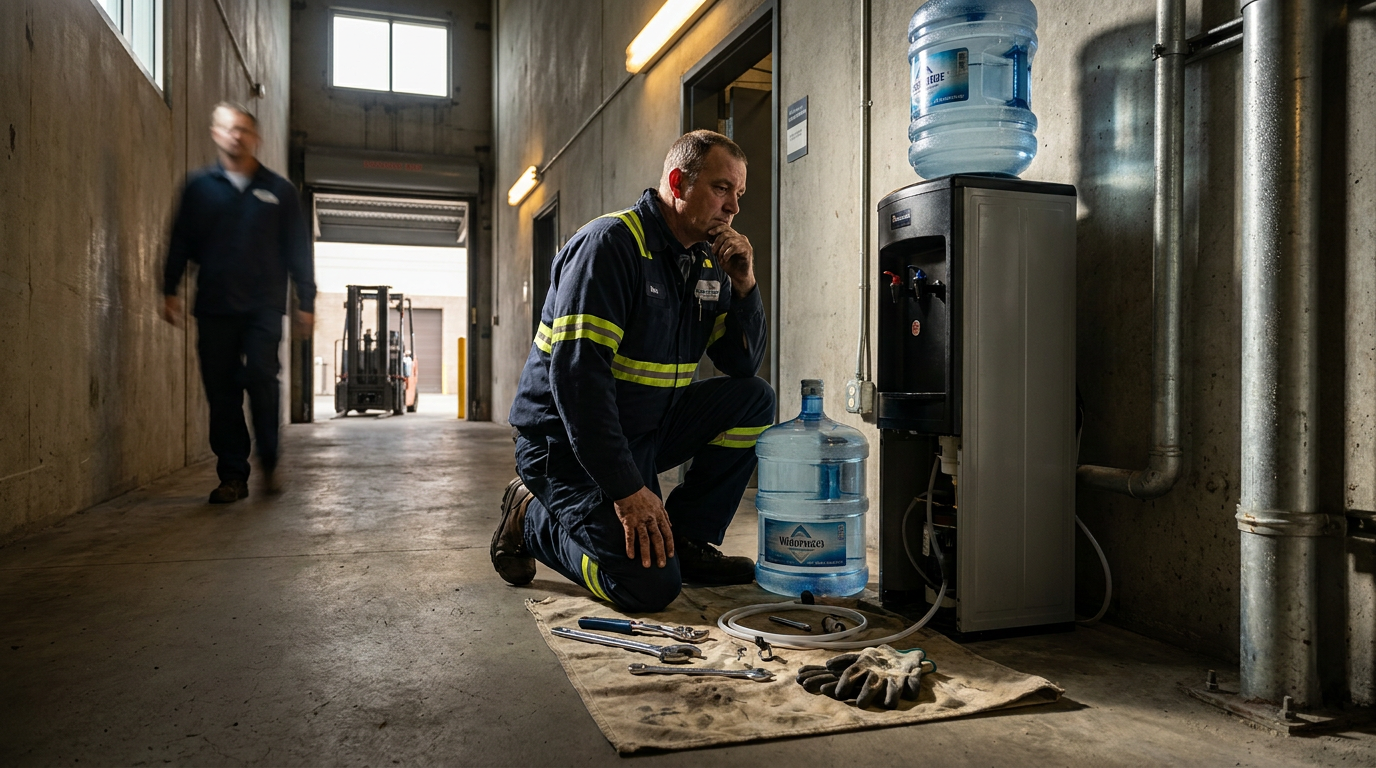
Bottled water coolers have been called a dying business for ten years. They still make up more than half of every water cooler placed across Europe. The obituary keeps getting written. The market keeps not reading it.
Quick definitions first. BWD (bottled water dispense) means a cooler fed by large refillable bottles. POU (point of use) means a cooler plumbed straight into the mains, so no bottles get delivered. ITS (instant taps) means a counter-top or under-counter tap that pours boiling, chilled, or sparkling water. The industry story says every market walks up a ladder: bottles first, then mains-fed coolers, then instant taps. Most of the money still sits on the first rung.
The share barely moves
Look at the whole European fleet and the mix hardly shifts year to year. Bottled is still just over half of all machines in service. On current forecasts, bottled will still be about half the European fleet at the end of the decade. That is after years of plastic rules, ESG buying, PFAS headlines, and heavy marketing for mains-fed coolers. Note: PFAS means the "forever chemicals" now regulated in drinking water.
This is the part that catches people out. The switch is real, but it moves in tenths of a point a year. An installed base of millions of machines does not flip fast.
One number, sixteen different markets
The calm European average hides a fight underneath. Bottled is shrinking hard in the Alpine and Nordic markets and growing fast in the South. Switzerland has roughly halved its bottled share in five years. Spain has gone the other way and keeps adding bottled coolers, mostly in homes.
So a single "European conversion rate" describes no real market. There is no one bottled market in Europe. There are sixteen national ones, and several are moving in opposite directions at once. Anyone who prices a book off the continental average is using a number that fits nobody.
Why the base moves so slowly
Three plain reasons. First, rental contracts run for years, so a fleet only turns over slowly. Second, operators have real money sunk in bottles, racks, and delivery routes, and they sweat those assets hard. Third, a large slice of bottled placements has no mains option at all. Building sites, factories, events, backup supply, and many homes cannot be plumbed. A tap needs a pipe.
That last point is the one the "bottled is finished" story forgets. Bottled coolers do jobs that mains-fed coolers cannot reach. In the premium northern markets, the bottled accounts that remain are corporate and pay the highest rentals in Europe. Those are good customers.
What this means for operators and investors
Treat the switch as a 15-to-20 year arc. It is not a five-year event. Operators who serve both formats and convert accounts one at a time keep winning. The ones who bet the whole business on a fast, clean switch have been early and wrong for a decade.
For buyers, the lesson is sharper. Do not price a bottled book on a blanket "it's dying" discount. Ask how much of it is actually convertible, meaning how many accounts even have a mains line nearby. A premium bottled book that has already shed its easy-to-convert accounts is a steady annuity. A cheap, high-volume bottled book in a market that is still growing bottles carries the real transition risk. Its lowest-value accounts meet the 2026 rule wall first.
The bottled cooler is one half of a market that keeps paying, in some places for a long time yet. The winners will read each country on its own terms and stop waiting for a switch that arrives one account at a time.
📈 See how each market is really moving
The switch runs at a different speed in every country. The Water Dispense Insights resource hub breaks down the segment shifts, pricing, and operator moves market by market, so you can read a book before you price it.