The Water Dispense Market Nobody Is Watching Has 2.5 Million Units
By Zenith Water Dispense Team ·
Eastern Europe holds close to 40% of all European water dispensers — yet the structural shift that reshaped Germany and France has barely started there. EU regulations now apply across every Eastern European member state. The operators and investors who move early will set the pricing norms for the next decade.
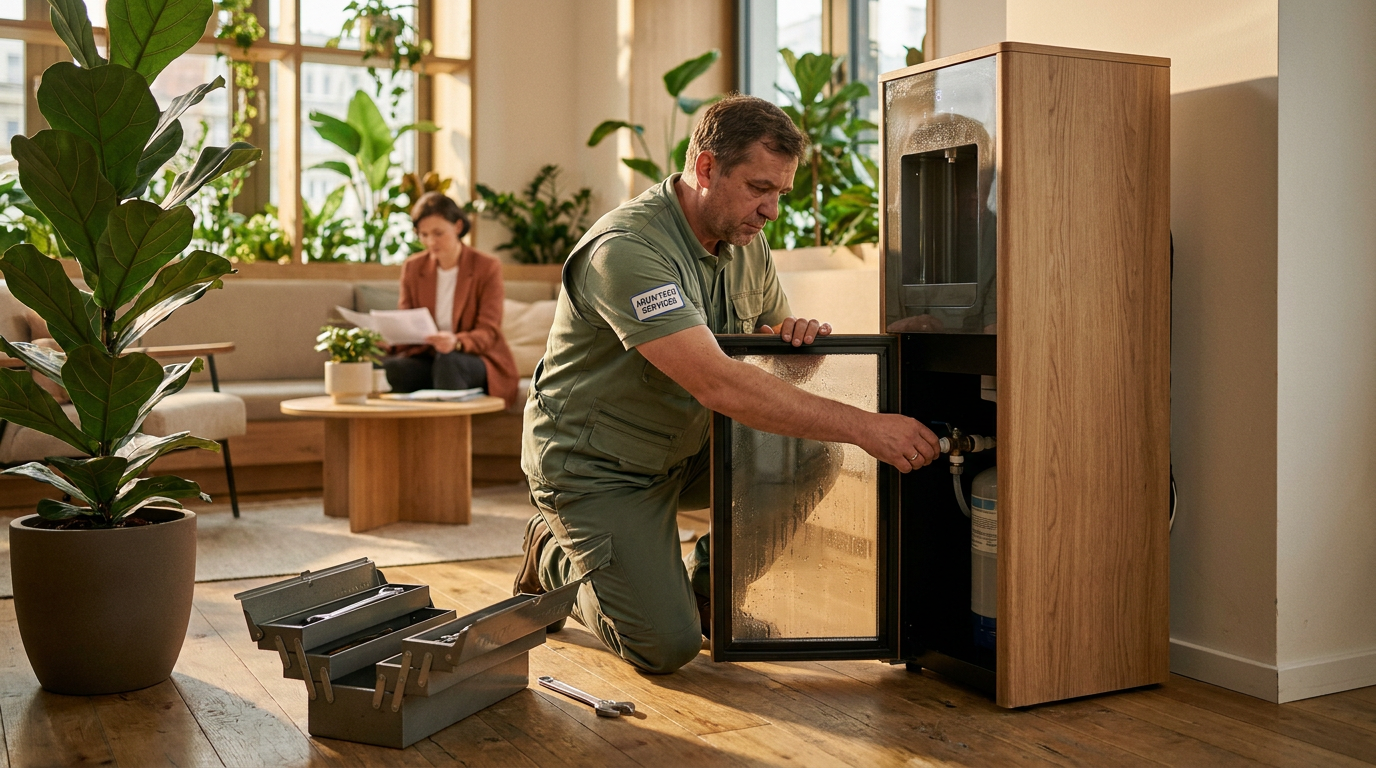
Eastern Europe holds close to 40% of all European water dispensers. Most operators and investors haven't noticed. That is about to change.
The headline water dispense markets — Germany, France, the UK — get most of the attention. But to the east, a fleet approaching 2.5 million units sits largely uncovered. It is built almost entirely around BWD — bottled water dispensers, the coolers that run on delivered 15 or 19-litre bottles. POU — point of use, mains-fed coolers — is a minority product in most markets. ITS — instant tap systems, the premium counter-top units delivering boiling, chilled, and sparkling water — barely registers in the data.
This is not a sign of failure. It is a sign of timing. Eastern Europe is, structurally, where Western Europe was approximately a decade ago. And the forces that transformed the West are now fully active in the East.
A Region Still Built Around the Bottle
The scale of Eastern Europe's BWD dominance is striking when you look at it market by market. Most countries in the region have four out of every five cooler units running on delivered bottles. Poland — one of the region's largest markets — has a fleet size comparable to Germany. Its structure is far closer to Southern Europe: BWD-dominant, with minimal POU and almost no ITS.
This matters for two reasons. First, a BWD-heavy fleet carries the highest operating cost per placement, the greatest regulatory exposure, and the lowest revenue per unit of any water dispense model. Second, the conditions that forced Western Europe's BWD operators to rethink their model are now active in Eastern Europe too.
The operators and investors who understood Western Europe's transition early captured the largest consolidation windows before M&A repriced the market. Eastern Europe is opening the same window right now.
Two Markets Already Moving
Not every Eastern European market is at the same point.
The Czech Republic is the most advanced in the region. POU has already crossed 40% of the fleet. ITS — while still small — is beginning to emerge. The market looks closer to Germany or Switzerland five years ago than to its Eastern European neighbours. The Czech Republic is the leading indicator for where Eastern Europe's premium segment is heading.
Romania is the most actively consolidating market. In November 2024, Axel Johnson — a PE-backed investor — acquired La Fântâna, the dominant operator serving Romania and Serbia. A single deal restructured the region's competitive landscape. It brought one of Europe's quietest large markets onto the radar of organised capital for the first time.
Latvia and Serbia sit in a different category entirely. A large share of their installed base is made up of passive dispensers and pumps — not powered coolers. These markets are, in structural terms, pre-BWD. The conversion arc ahead of them is longer than anywhere else on the continent.
The Regulatory Forcing Function Has Already Arrived
Here is the key difference from Western Europe a decade ago: the regulation is not on its way. It is already here.
EU member states in Eastern Europe include Poland, Czech Republic, Romania, Hungary, Bulgaria, Croatia, Estonia, Latvia, Lithuania, Slovakia, and Slovenia. All of them are bound by the same EU rules as France and Germany.
The EU Drinking Water Directive — which sets binding monitoring limits for PFAS, per- and polyfluoroalkyl substances — entered force in January 2026. It applies across all 27 EU member states, from Dublin to Tallinn. BWD operators have no filtration layer to answer it. The bottle is the vessel. If the source water carries PFAS, so does the product.
The BPA ban — bisphenol A, a chemical found in polycarbonate bottles — takes effect on July 20, 2026. That is 44 days from today. The PPWR — Packaging and Packaging Waste Regulation — bans PFAS in food-contact packaging from August 12, 2026. Both deadlines apply equally to a BWD operator in Warsaw and one in Paris.
A BWD-heavy Eastern European fleet carries maximum packaging compliance exposure at the least-advanced transition point in Europe. These operators face the same deadline with far fewer POU units to absorb the shift.
What This Means for Operators and Investors
The Western European playbook is not a prediction. It is a proven sequence.
In Germany, BWD contracted sharply over five years. Culligan consolidated the shrinking bottled base. Revenue per placement rose as low-value accounts churned first. The same pattern ran in France, Switzerland, and Austria. Each time, early movers — with POU credentials, PFAS filtration answers, and pricing built around value per placement — captured the best returns.
That sequence requires the same conditions to start: PFAS regulatory pressure, credential-based buying at enterprise level, and ESG requirements entering FM tenders. All three are now active across EU Eastern Europe.
Three markets deserve close attention right now. The Czech Republic is the most WE-like and already in transition — a live benchmark for timing the others. Poland is large, structurally early, and has seen very little organised M&A so far. Romania has an established PE entry point after the La Fântâna deal, with consolidation still at an early stage.
The water dispense industry spent fifteen years writing the Western European transition story. Eastern Europe is only on the first page of its own.
Operators who move now will not be competing against themselves. They will set the benchmark every subsequent buyer has to compete against. The window is open. It will not stay that way once the first cross-regional M&A wave begins.
🤝 Your Brief Doesn't Have to Fit a Standard Package
Looking at Eastern Europe, a specific country mix, or a deal structure that doesn't fit a shelf product? POU only, BWD only, two markets, a custom competitive analysis — if the brief is specific, send it directly and we'll scope something that works.