Europe's eighty-point sparkling gap in the POU water cooler market
By Zenith Water Dispense Team ·
Sparkling is a country habit before it is a hardware feature. Germany and Spain run the same plumbed formats in opposite directions.
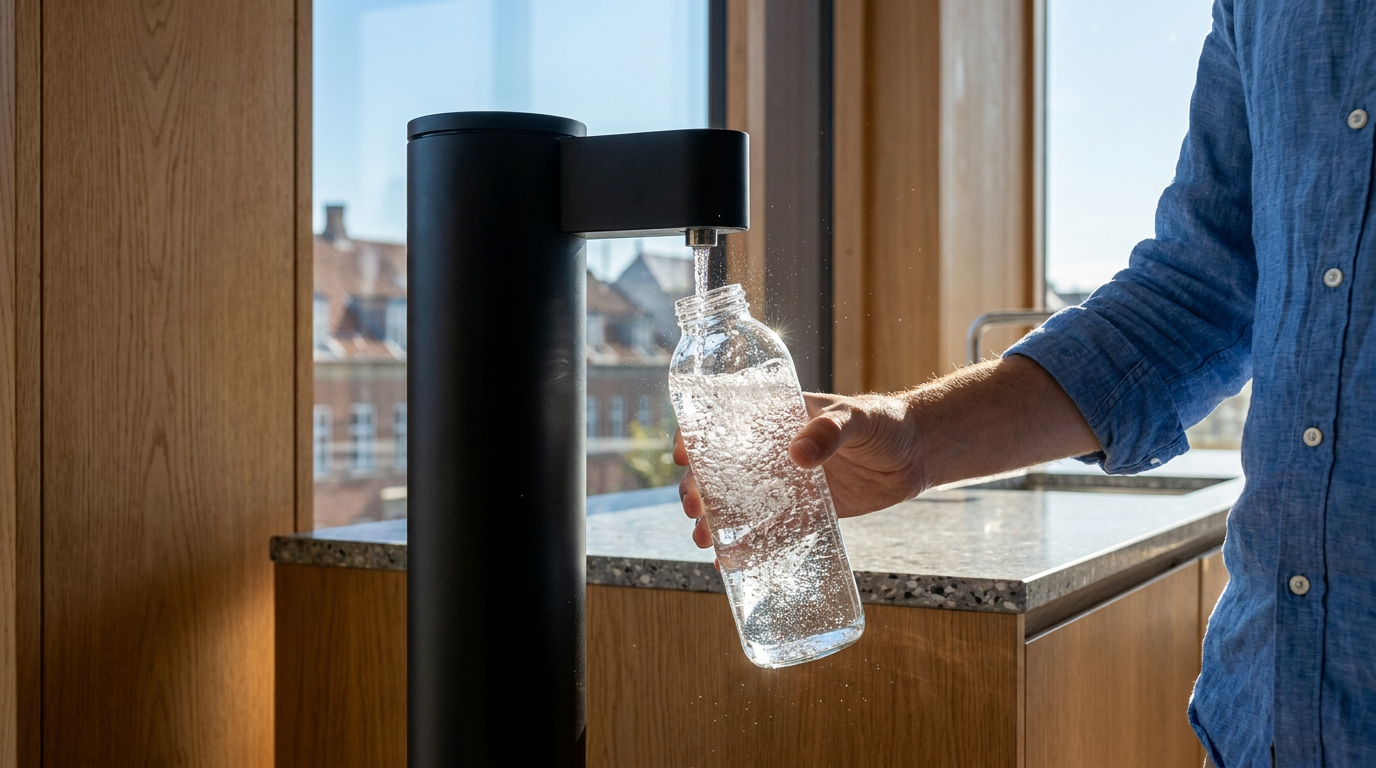
Every sparkling pitch I hear casts the tap as the sparkling machine. The cooler gets cast as the plain one. In market after market our own numbers say the reverse.
Germans drink 125.6 litres of mineral water a head each year. Only about a quarter of that is still. The rest carries gas, and most of it carries plenty. Those are the German mineral water trade body's own 2024 figures.
The habit belongs to the country before it belongs to the machine
Across Europe the two plumbed formats have converged. A plumbed cooler goes by POU in this trade, short for point of use. Mains-fed coolers and instant taps are now about as likely as each other to pour sparkling. Our 2025 model puts both shares in the mid to high thirties.
That average is useless on its own. The country spread behind it runs past eighty points, and it runs in both directions.
Germany and Spain run the same formats in opposite directions
In Germany, approaching nine in ten mains-fed coolers can pour sparkling. Under four in ten German instant taps can. Worktop units like those are instant taps, shortened to ITS. In Spain the picture flips almost exactly. Barely one Spanish cooler in twenty is sparkling-capable, while nearly every Spanish tap is.
Portugal, Greece and Poland sit on the Spanish side. Finland, Italy, Denmark and Norway sit on the German side. Eight of Europe's larger markets have cooler fleets that pour sparkling more often than their tap fleets.
The mechanism is simple once you see it. Germany had the habit before it had the hardware, so sparkling got built into whatever machine arrived. Spain met the cooler as a still-water product for the home. Sparkling turned up later, on a tap, and the tap kept it.
Bottled asks nobody for permission
Bottled sits apart from all of this. Those machines are BWD in the trade, short for bottled water dispense. Each one takes a 19-litre bottle. Only a few per cent of those machines pour sparkling. That is a position, and it has its own logic.
A sparkling tap needs a plumber, a drain, a gas cylinder and somebody to swap it. The landlord usually has to agree. On a leased floor, in a listed building or on a short tenancy, none of that happens quickly. A bottled cooler can be drinking water by the afternoon, and no tap can match that.
The other side is real too. A plumbed fleet earns a steadier line, carries no route cost and has no bottle to wash. An operator holding both formats can answer a site that wants water this week. It can also answer one signing for ten years.
What the British number is actually saying
Britain owns the largest plumbed dispense fleet in Europe. Almost none of it carries gas. About one cooler in fifty is sparkling-capable, against roughly one tap in five.
Read that two ways. It is either the largest unworked sparkling opening on the continent. Or it is proof that British offices do not want it. The British bottled fleet pours no sparkling at all, so there is no habit waiting to be migrated.
One sparkling proposition cannot be priced across Europe
This is where it costs money. Where coolers already pour sparkling, a tap cannot sell on sparkling. It has to win on boiling water, on counter space or on speed.
Where coolers do not, sparkling is the entire reason a site changes format. It carries a price, and the gas and filter income comes with it. Sparkling is a paid upgrade in half of Europe and table stakes in the other half.
Where this lands in a 2027 plan
Set one European spec floor and you over-build for half the map. You under-build for the rest. A single sparkling tariff leaves money on the table in Spain. The same tariff loses tenders in Germany.
Anyone underwriting a European dispense book should ask for the sparkling share by format and by market. One blended number hides the whole problem. A summary page can show forty per cent sparkling-capable. The country paying the rent can be at two.
🎯 This is how we read a market before a client acts
A spec or pricing call on your desk this quarter has a short window. Bring us the market and we will tell you which half of Europe it behaves like.
P.S. Which half of Europe does your next market behave like?
Still and sparkling are split by format and by country inside the 2026 Zenith Water Dispense Market Reports.
Skip nothing in Europe and the count lands at thirty-one markets.
Five more files exist beyond it, for Turkey, South Korea, the UAE, Mexico and Japan.
Every country file carries a 2030 outlook alongside the 2025 actuals.
The workbook and the chapter travel together, so neither one has to be chosen.
Built from direct interviews with local operators and data partnerships in every market we cover.