Europe's water cooler market grows fastest where water is scarcest. Brussels is drafting the rules.
By Zenith Water Dispense Team ·
On 14 September the European bottled water trade body wrote to Brussels. It signed alongside the public water utilities. Both want legal targets for keeping water in the ground. For water dispense operators it moves the risk question from format to location.
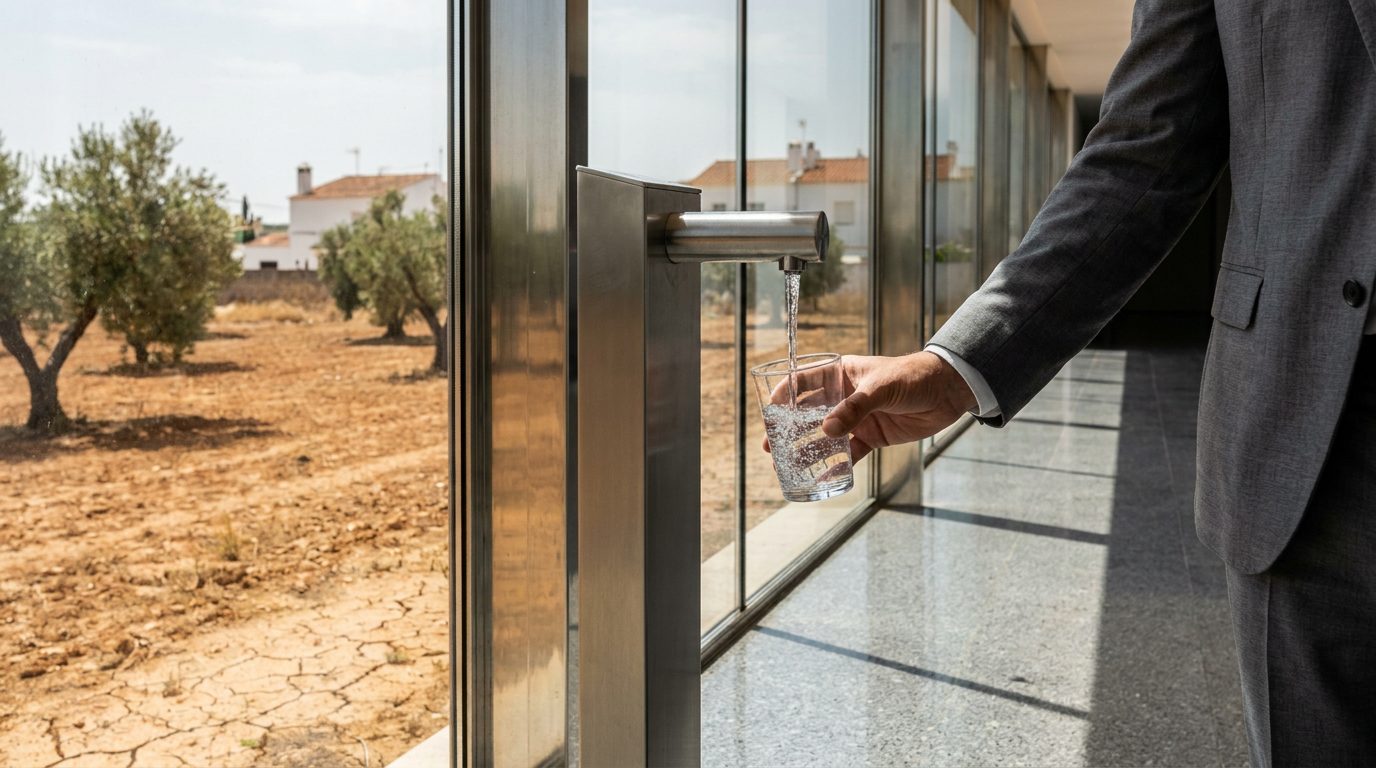
The bottled-versus-mains argument in water dispense has become a distraction. I say that because of who signed a letter in Brussels this month. On 14 September, Natural Mineral Waters Europe put its name beside EurEau. That body speaks for Europe's public water utilities.
Those two bodies compete for the same glass of water. More than 30 organisations signed with them, including WWF, Eurocities and The Nature Conservancy. The letter went to Commission President Ursula von der Leyen. They are all asking for one thing: legally backed targets for keeping water in the ground.
What the signatories want written into law
The signatories want nature-based measures written into the coming European Climate Resilience Framework. In plain terms that means wetlands, floodplains, peatlands and healthy soils used as storage. Those systems hold rainfall and refill aquifers. The letter asks for national targets on extra natural water retention, with finance attached.
It is careful on one point. The group does not want nature used instead of pipes and treatment plants. It wants both. The Commission's own consultation summary found nature-based measures raised in at least 60% of responses. On that showing the framework is likely to carry them.
The number that should end the efficiency pitch
Here is the figure that reframes the whole debate. EU water abstraction fell 14% between 2000 and 2023. Over the same years the area under water scarcity did not shrink. That is the European Environment Agency's own reading.
Read that twice. Europe took less water out for two decades. The stressed area stayed where it was. Scarcity hit 28% of EU territory and 32% of the population in 2023, in at least one season. The yearly average sits near 30% of land and 33% of people.
This matters commercially. Most POU (point of use, mains-fed) sales decks open on water saved against bottled. The benefit is real. Keep selling it. It is also an argument Brussels has already run and found does not work on its own. Efficiency did not shrink the stressed area. Retention and recharge are what the coalition wants now.
Growth is concentrated where water is short
Now lay the two maps on top of each other.
The EEA names Greece, Romania, Portugal, Italy and Spain as scarce in spring and summer. Cyprus and Malta are worse. Turkey is the most stressed country in the wider EEA group, and it is a live dispense market.
Zenith's 2026 data makes Spain the largest water dispense market in Western Europe, past one million units. That was its thirteenth straight year of growth. Spain added more than 100,000 net placements in 2025. It is forecast to approach 1.4 million units by 2030. Across the continent that is 6.6 million units and revenue past €2.5 billion.
So the industry's best growth engine sits inside some of its driest geography. Italy, Portugal, Greece and Romania appear on both lists. Exposure in this business follows the map before it follows the machine mix. Very few operators model it that way.
Where bottled holds an advantage nobody counts
Bottled water dispense takes most of the criticism in this debate. One point in its favour goes unsaid.
A bottled operator physically reaches every customer site on a fixed cycle. Drivers enter the building, see the floor, count the machines and talk to someone. That delivery round is a rolling survey of the whole customer book. It costs nothing extra to run. POU and tap fleets get a visit when something breaks or a filter falls due.
If supply risk turns into a location question, that field presence is worth money. A bottled operator can say where its volume sits, building by building, faster than anyone else here. Hardly any have tried.
A fourth-quarter clock to work to
The Commission plans to adopt the climate resilience framework in the fourth quarter of 2026. It will mix binding rules with softer instruments. It follows the European Water Resilience Strategy of June 2025. That strategy already set a 10% EU water efficiency target for 2030.
Three things follow for operators. Abstraction permits get harder to renew in stressed basins, and named sources feel it first. Municipal supply in those same basins carries restriction risk, which lands on POU and tap fleets. Large corporate buyers with water targets will start asking suppliers for basin-level answers.
The tender question is moving from how much water you save to where you take it from. Operators who can answer by postcode will be a year ahead when the framework arrives.
🎯 This is the thinking we bring to client projects.
If today's topic touches a decision on your desk this quarter, start the conversation before the window closes.
P.S. If a board asks which of your markets carry the most exposure, guesswork will not survive the meeting. Thirty-plus country models sit inside the 2026 Zenith Water Dispense Market Reports. Each is built from unit level across BWD, POU and ITS. Named operators, what they hold, the money behind them, and a line running out to 2030. Household and business demand are counted apart. West and east, the European set is finished. Add five more if you need them: Turkey, Japan, South Korea, Mexico and the UAE. Delivery starts with the Excel, and the written report follows if you ask. Built on the world's largest water dispense database. Browse the 2026 reports.