Which buildings are converting to POU water fastest? The answer sits outside the office
By Zenith Water Dispense Team ·
Conversion to mains-fed water runs at very different speeds by building type. The workplace holds most of Europe's machines and changed format slowest last year. Public buildings moved first, and EU law is part of the reason.
The question I keep putting to operators with a conversion target is a short one. Which kinds of buildings are you converting, and who drew up that list? Almost every answer I get describes a format and never a building type.
One public number sets the scene. On 1 September 2026 Eurostat published the half-year tourism figures. EU accommodation took 1,321 million overnight stays in the first six months. That is 1.7% up on the same period in 2025. Nights booked from abroad rose 2.5%, roughly three times the domestic rate. Hospitality demand keeps climbing. The machines in those buildings are also changing format faster than office machines.
Conversion has a speed limit, and the building sets it
A POU unit is a point-of-use cooler, fed straight from the mains supply. ITS covers instant taps, which sit in a worktop and pour hot or cold on demand. Together they are the plumbed half of the market. BWD, or bottled water dispense, is the other half.
Our 2026 European model tracks every machine by building type across 31 markets. Rank those building types by how far their plumbed share moved in one year. The order surprises most people in the trade. Transport hubs moved fastest, then education, leisure and healthcare. The workplace came last.
The gap is wide. Transport hubs shifted their format mix roughly three times as fast as offices. The workplace is close to three in five of every dispense machine in Europe. The channel holding the most hardware is changing shape the slowest.
Transport hubs did something no other building type did
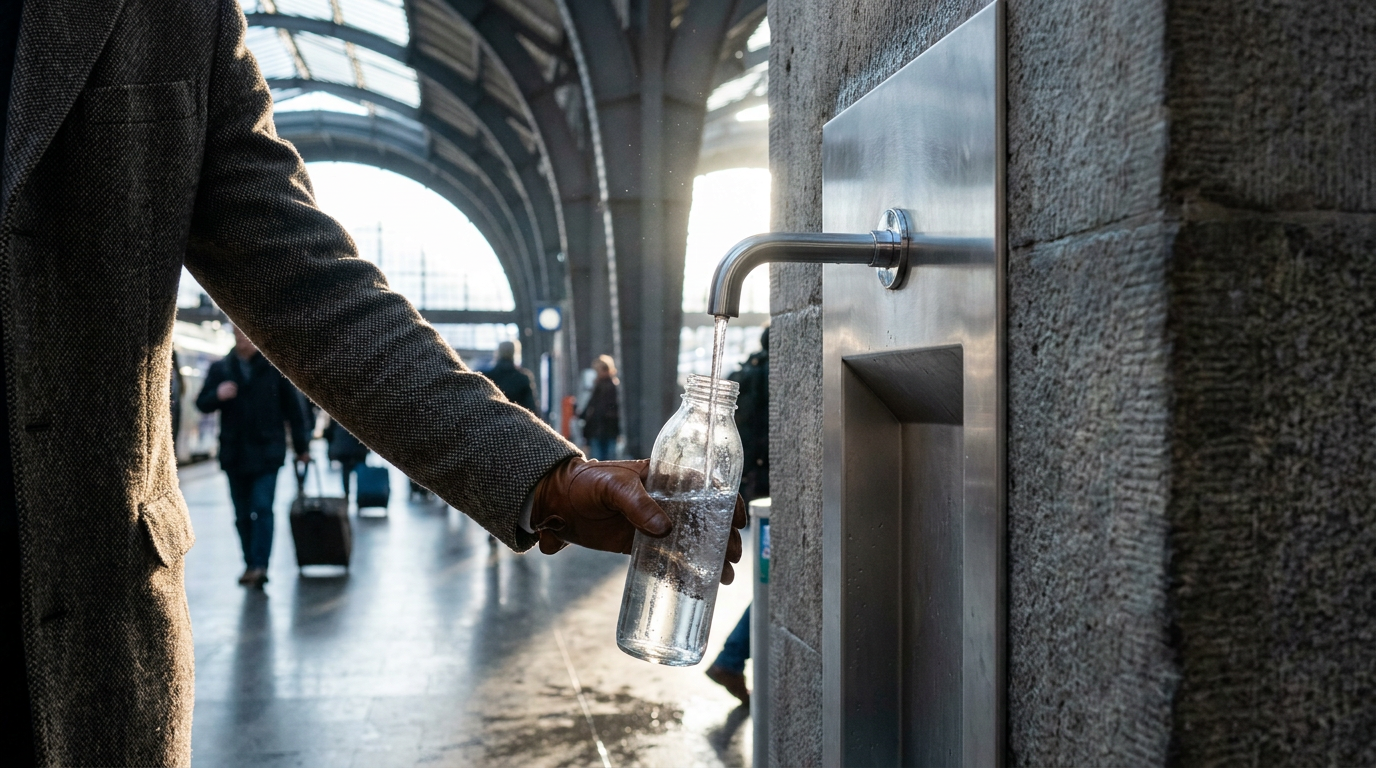
Stations and airports were the only building type where total machine numbers fell last year. The bottled fleet shrank there while the plumbed fleet grew. In transport, conversion replaces machines instead of adding them.
A single tap in a busy concourse takes the place of a whole bank of bottled units. The site gets a faster unit and the operator loses the delivery round. The unit count drops while revenue holds. Anyone reading transport as a shrinking channel is reading a format change as a demand problem.
Brussels wrote part of this list in 2023
There is a legal reason the public-access buildings moved first. Article 16 of Directive (EU) 2020/2184 is the recast Drinking Water Directive. It tells member states to set up indoor and outdoor water equipment in public spaces. The duty applies where that is technically possible. The same article pushes free or cheap tap water in public buildings and catering sites. Member states had to transpose the directive by 12 January 2023.
A fill point in a public space is a plumbed job almost by definition. Nobody runs a bottle round through an airport to meet a public-access duty. The law handed four building types a reason to plumb. Those four sit at the top of our conversion table. I would not claim the directive did all of it. I would say it is the cleanest explanation anyone has offered.
Hospitality has already done most of its converting
Restaurants, hotels and bars are a special case worth separating. About three-quarters of the dispense machines in European hospitality are already plumbed. That sits far above any other building type. The conversion argument has largely been won there. Its share moved less last year than education or healthcare did.
So hospitality is now a volume and premium story rather than a conversion one. In an office, about half the fleet is still bottled. A commercial kitchen plumbed in years ago, so the same pitch lands differently.
A bottle on top is a receipt the public can read
Bottled dispense has a real advantage in exactly these buildings. Operators rarely sell it. A full bottle is visible proof that the water is there and that somebody changed it. A visitor, a patient or a parent can see that from across the room.
A plumbed tap gives no outward sign that its filter was serviced. In buildings where the drinker is a stranger, visible proof does commercial work. Bottled sells trust at a glance, and no tap has found a way to copy it. Bottled held its ground in education, leisure and retail last year. Plumbed grew around it.
Rebuilding the pipeline around property types
Most conversion plans are built around a format target and a customer list. Very few are built around building types. That is cheap to fix and it changes where the engineers go.
The buyers in schools, hospitals and stations are slower and more procedural. They are also more loyal once you are in, and they publish their tenders. Anyone underwriting a European dispense book in 2027 should look at the building mix. It now predicts conversion better than the country does.
🧭 Weighing up where to point your conversion effort?
Send us the shape of the problem in a few lines. We read a selection of these properly. You get back a view on direction, scope and likely cost.
P.S. Does your plan know which building types your machines actually sit in? The 2026 Zenith Water Dispense Market Reports break every market down by format and by building type. Operators are named and sized, with a B2C and B2B split. Revenue runs from 2019 out to 2030. Coverage reaches 30-plus markets, every Western and Eastern European country among them. Japan, South Korea, Turkey, the UAE and Mexico sit alongside those. Trusted by industry leaders since 1998. One licence covers the working file and the write-up together. Browse the 2026 reports