Primo chose slower growth on purpose. Water cooler operators should copy it.
By Zenith Water Dispense Team ·
On 9 September, Primo Brands told investors its 2026 sales growth would be 2% to 4%, below the 3% to 5% it set at the merger. Profit and cash targets were left alone. The reason is what matters. The largest water delivery business in North America has stopped buying customers with discounts, and most European water cooler operators still do.
The easy read on this is a bottled water company in trouble. I read it as the best pricing decision anyone in dispense made this year. On 9 September, Primo Brands told investors its 2026 sales growth would land at 2% to 4%. The target set at the merger was 3% to 5%.
Primo is the largest water delivery business in North America. Chief executive Eric Foss and finance chief David Hass spoke at the Barclays global consumer conference. They lowered the growth number and left the profit and cash targets alone. Management called it a recalibration after integration problems. A refreshed set of targets arrives in spring 2027.
What sits behind the smaller number
The operational story underneath is good. Primo said on-time-in-full delivery is back above 90%. Warehouse out-of-stocks are gone. The company has posted two quarters of beats and raises on the top line.
So the smaller growth number has a cause most readers will skip past. It came down because Primo stopped buying customers.
Fewer sign-ups, better accounts
Primo told the conference it is rebuilding its delivery business around customer quality. Sign-up volume is no longer the goal. In the past it used heavy promotional offers to win homes and offices. Those offers filled the route and then emptied it again.
Now the company prices to what a customer is willing and able to pay. Management said the discipline has not cost it any acquisition volume. That is the part worth sitting with. The cheap deals were never the reason the customers came.
It also set out its pricing mechanics plainly. Existing customers get an annual increase in the low single digits. Delivery fees are the main national lever. That is a business raising price every year by design, and treating the route itself as the product.
Why most European operators do the opposite
When growth slows in Europe, the standard move is a discount. Free months, or a waived install. It holds the unit count, and unit count is what share tables reward. It is also the number a seller puts in front of a buyer.
Our own European data says the habit is expensive. Cancellation rates on bottled coolers vary by about two times across Western Europe. Same hardware, same water, same job. The gap holds year after year. We build these figures from direct interviews with local operators and from data partnerships in each market.
No product difference is wide enough to cause that. Pricing discipline and channel mix are. A market that sells cheaply churns at roughly twice the rate of one that holds its price. The cheapest markets to buy a customer in are the dearest markets to keep one.
What the delivery van is actually for
Read that sentence again, because the format it describes is one most of this industry has already dismissed. BWD means a cooler fed from 15 or 19 litre bottles. The company publishing a service recovery here is a bottled delivery business. The delivery is the reason it can.
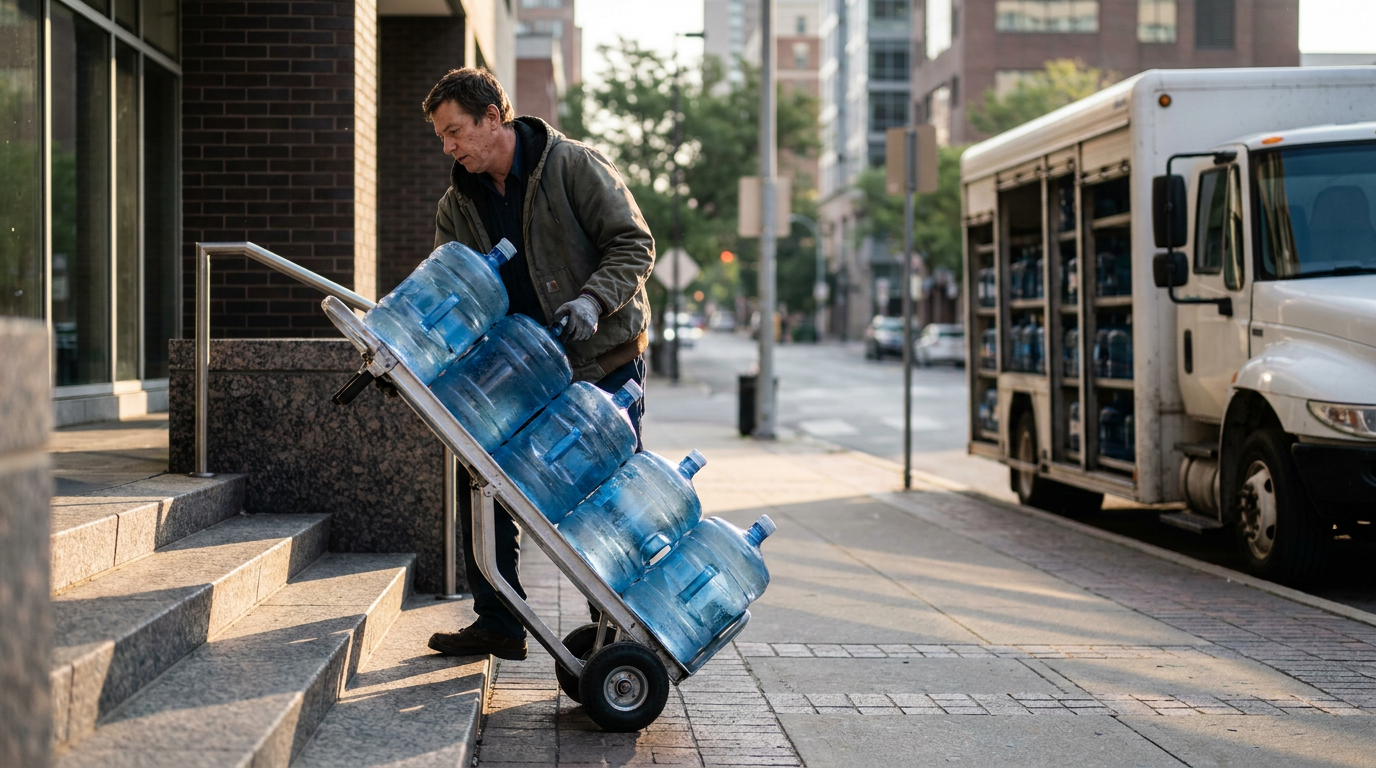
A bottled route sees the customer twenty times a year or more. A mains-fed cooler might get two visits in the same period. POU means point of use, a cooler plumbed into the water supply. That contact is a retention asset. It is also the cheapest way to sell a second product into an account you already have. Primo calls that attachment selling.
Across most of Europe the format has given up share every year for a decade. Nothing here changes that. Bottled still has one thing mains-fed lacks. A paid reason to stand in front of the customer every fortnight. Operators cutting route frequency to save cost should price that loss before they book the saving.
Two numbers that beat unit count
Unit count is the metric this industry runs on. It hides the thing that decides what a book is worth. Two figures fix that.
The first is revenue still in place twenty-four months after signing, split by how the account was won. Discounted accounts and full-price accounts behave very differently. Most operators have never split the number.
The second is the share of new accounts signed at full list price. If that share is falling while unit count rises, the business is buying growth and calling it demand.
Primo has told the market it will grow more slowly for a while and earn the same money. Buyers understand that trade and pay for it. Operators who copy it will look worse on a share table next year. They will look better in a sale room the year after.
📞 Exploring a water dispense market this year?
Book a 30-minute call with Akos Petri to talk through what is moving in West Europe, East Europe or the US, and where the best entry or growth openings sit right now.
P.S. Do you know how many of your accounts are still paying two years after they signed? The 2026 Zenith Water Dispense Market Reports cover more than 30 markets. That means every West and East European market, plus Japan, Turkey, UAE, South Korea and Mexico on request. Each report is a full BWD, POU and ITS model. It carries operators and shares, the B2C and B2B split, revenue and a 2019 to 2030 outlook. Excel, with the written report on request. Trusted by industry leaders since 1998. See them here: https://waterdispenseinsights.com/reports