Half of Turkey's homes now filter their own water. The water cooler market is misreading the POU water shift
By Zenith Water Dispense Team ·
Turkey's packaged water association reported bulk bottle volume rising in 2025. A year later it reports the sector running far below that. Its chairman blames household budgets, a cool summer and home filtration at the same time. For water dispense operators anywhere, the lesson is that one falling volume line rarely has one cause.
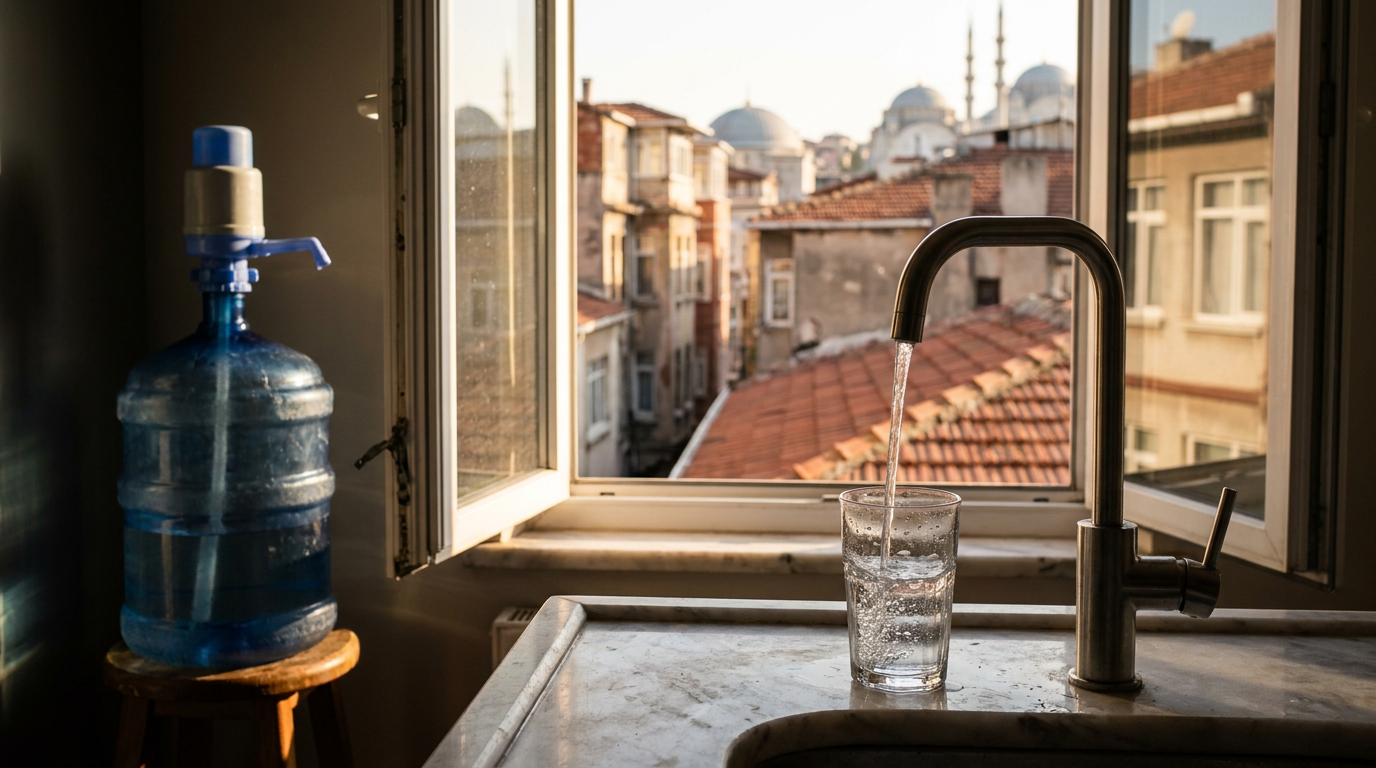
I keep meeting operators who read one falling volume line and give it one cause. Nine times out of ten they name mains-fed conversion. Turkey's packaged water association has just published figures that make the habit look expensive.
SUDER is the producers' body for packaged water in Turkey. Its published 2025 figures put the market at 11.4 billion litres, down 3.1% on the year before. The detail underneath runs the other way from that headline.
Two numbers from the same association
The 19 litre returnable bottle is called a damacana in Turkey. Delivered bottles on a cooler sit in the BWD column, bottled water dispense. Damacana volume rose 4.8% in 2025 to 5.4 billion litres. Smaller packs went the other way, down 9.3% to 6.0 billion litres. Bulk took 47% of all packaged water litres.
Then came August 2026. SUDER's chairman described the sector running about 30% below the year before. He gave three causes at once: household budgets, a cool summer and home filtration. Two readings of one market, months apart, pointing opposite ways.
Filters went in and no operator signed anything
One of those three causes deserves its own line. The chairman put home purification at around half of all Turkish households. Those filters count as POU water, point of use, fed by a pipe instead of a bottle. Half a country's homes is a very large installed base.
Europe is still arguing about how fast that conversion will run. In Turkey the household side has largely run already. Retail shelves and independent installers carried it, with dispense operators barely involved. Most of those units were bought outright, so no rental followed them.
Zenith's own Turkey model sits underneath this. Manual pumps and stands outnumber coolers in the installed base there. Mains-fed dispense tracked through operators is growing from a small base at a mid single-digit clip. A market can convert to mains-fed and hand the dispense industry almost none of the recurring revenue.
A cool summer sits inside the drop
Weather moves bottled water volume hard, and it moves it fast. A cool July in a delivery market can take a tenth off the round. Dispense forecasts almost never carry a weather term at all. Neither do most diligence models.
That matters because the three causes have different half-lives. Conversion is permanent once the filter is on the wall. Budget-driven downtrading reverses when real incomes recover. A cool season reverses by itself the following year. Charging the whole drop to conversion makes a market look more finished than it is.
Get that attribution wrong and the errors compound. You retire route capacity you will need again. You price an acquisition off a base that was never really lost. You also hand a competitor the accounts you decided were structurally gone.
Where bottled is the only thing that fits
There is a floor under bottled that the conversion story keeps skipping. A filter needs a pipe, a shut-off valve, a drain and a socket within reach. Plenty of buildings have none of those anywhere near where people actually drink. Older stock, rooftop tanks and long internal runs make it worse.
Turkey carries a lot of that stock, and so do Italy, Greece and Portugal. In those sites bottled is the only format that can be installed at all. A delivered bottle also keeps working when the building's supply is cut.
What to change before the next forecast
The practical work is attribution, and it is cheaper than it sounds. Separate what a filter took from what price took, then put the rest against weather. Each bucket carries its own recovery assumption, and only one of them is permanent.
Operators in converting markets face a harder question about channel. Retailers and fitters sold those Turkish household filters. Operators leased almost none of them. If your market converts the same way, the installed base grows while the rental line stays flat. Deciding whether to chase that sale is a commercial choice, and it is due now.
Buyers can run the same test on a target. Ask how it split last year's volume decline. A management team that answers with one cause has not done the work. The answer changes what the recurring revenue is worth.
SUDER will publish again, and the next set will settle the argument one way or the other. Operators who have already split their own numbers will know what it means. The rest will still be guessing.
📞 Want a second read on a volume line that just moved?
Thirty minutes is usually enough to separate what is permanent in a market from what is seasonal. Bring your own numbers and we will work through them.
P.S. Reading a whole market off one association figure is thin ground for a budget. Thirty-plus country models sit behind the 2026 Zenith Water Dispense Market Reports. They are built on the world's largest water dispense database. The European coverage has no gaps at all. Five countries beyond it unlock on request, namely UAE, Turkey, Mexico, Japan and South Korea. The model separates what households buy from what businesses buy. Operators, shares, revenue and the run to 2030 all sit inside it. Everything lands as a working Excel file, with the full written report available alongside it. Open your market.