From January, a water cooler contract is scored on who you employ
By Zenith Water Dispense Team ·
On 15 September, Coca-Cola published a count of its local jobs and local spend. Three weeks earlier the Cabinet Office rewrote the UK Social Value Model. From 1 January 2027 it scores good jobs and skills on public tenders worth 1 million pounds or more. Operators have about 15 weeks to build a file nobody has asked them for.
I keep watching dispense operators build the same bid file. Carbon saved, plastic avoided, a line about recycling. Coca-Cola spent money last week proving something else. UK public buyers are about to ask for that instead.
On 15 September the Coca-Cola Company published an independent study of its American footprint, run by Steward Redqueen. One line in it does all the work. The Coca-Cola system keeps 98 cents of every dollar spent on its drinks inside the US economy. It does that by sourcing, employing, producing and distributing locally.
What Coca-Cola actually bought
The study covers the company's US operations and its 61 bottling partners. It reports 85 billion dollars added to US GDP in 2025. Close to a million jobs supported. About 37 billion dollars spent with American suppliers. The company also committed 10 billion dollars to US plants, depots and offices between 2026 and 2030.
Every figure there is counted, dated and published. What Coca-Cola bought is a defensible number about local jobs and local money. A procurement officer can quote a number like that in a scoring sheet. A carbon pledge does not survive the same test.
The UK has put a date on the same question
The Cabinet Office updated PPN 026 on 5 August 2026. PPN means procurement policy note, the rulebook central government buyers follow. It sets out a rewritten Social Value Model. Buyers should apply it to any tender started on or after 1 January 2027. That is about 15 weeks away.
The scope is narrow and clear. It covers central government departments, their executive agencies and arm's length bodies. It bites on contracts worth 1 million pounds or more including VAT. From 1 million to under 5 million pounds, social value must carry at least 10% of the total score. At 5 million and above, at least 20%.
On a national water contract, a fifth of the marks now sit outside price and service quality.
The model narrowed to jobs and skills
Now look at what the model actually rewards. The rewritten version has only two outcomes. Outcome one is good jobs: creating or keeping quality jobs, fair working conditions and fair pay. Outcome two is skills: training and retraining, in-work progression, and a talent pipeline.
Carbon is not one of them. The government's own wording is about good British jobs, skills and opportunities in every postcode. Three years of work on a carbon story builds the wrong file for this tender. That story still wins private contracts. It still matters to corporate buyers. It earns nothing under these two headings.
There is a sting for the winners too. On contracts of 5 million pounds or more, at least one jobs target must be set. It is published on the government platform and reported every year. Weak delivery against that target can be used to exclude a supplier from later tenders. A promise made to win one bid becomes a condition of making the next one.
Why the van is now an asset on the bid
This is where the bottled trade has an argument nobody has paid it for.
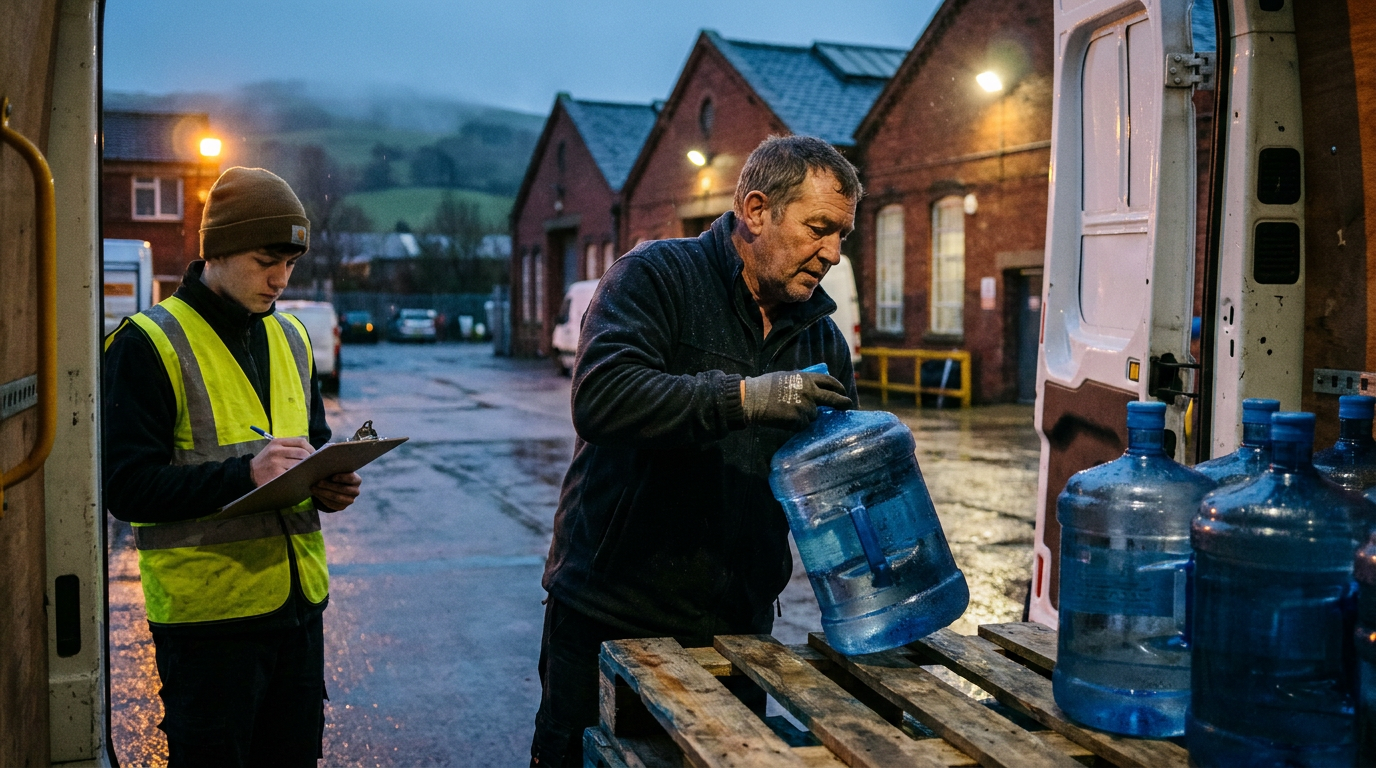
BWD means bottled water dispense. A van drops full bottles at the door and carries the empties back. It is a people business. Drivers, depot staff and route technicians sit on a payroll, in real postcodes, close to the customer. Zenith's UK model tracks millions of bottled deliveries a year. A person makes every single one. Operators tell us those numbers themselves, market by market, which is why they hold up.
A mains-fed operator runs leaner. POU stands for point of use. No bottles arrive at all, because the machine is wired into the building's own water line. ITS stands for integrated tap systems. Think of the office kitchen tap that gives you boiling and sparkling water on demand. Both formats install once and come back for filter changes. That lean cost base is a genuine commercial strength. Under a jobs-and-skills score it reads as a smaller local contribution.
So the format losing office share on cost has the better answer to outcome one. Mains-fed will keep taking that share, because the economics are good and buyers like the simplicity. Bottled operators file the route under cost. They should present it as employment inside the buyer's own area.
What to do before January
Two questions decide whether an operator can score here at all.
First: how many of your people live and work inside the area a given contract serves? Very few operators can answer by postcode, because no buyer has ever asked them to.
Second: what are you already doing on training that would count? Driver qualifications, apprenticeships and promotion from warehouse to route all qualify. Most operators run these informally and write none of them down.
The operators who win work in 2027 will be the ones counting this month. Starting to write the answer in December is too late, because the evidence has to already exist.
Three numbers are worth building now:
- The share of your payroll living within 30 miles of your largest contracts.
- Training days per employee, recorded and dated.
- Local supplier spend as a share of total spend.
For anyone buying a dispense business, this adds a line to the checks. A target with a documented local workforce and training record holds its public book more easily. A target without one carries a re-tender risk that no price adjustment will fix.
💬 You don't need a written brief.
Tell us what you are weighing up, and we will come back with the likely project scope, recommended direction and cost range.
P.S. Do you know how many of your staff live inside the areas your biggest contracts cover? The 2026 Zenith Water Dispense Market Reports cover 30+ markets. That takes in every West and East European market. Japan, Turkey, UAE, South Korea and Mexico come on request. Each report carries a full bottled, mains-fed and instant-tap model. You get operators and shares, the home and workplace split, revenue and a 2019 to 2030 outlook. The Excel and written report come on request. Trusted by industry leaders since 1998. https://waterdispenseinsights.com/reports